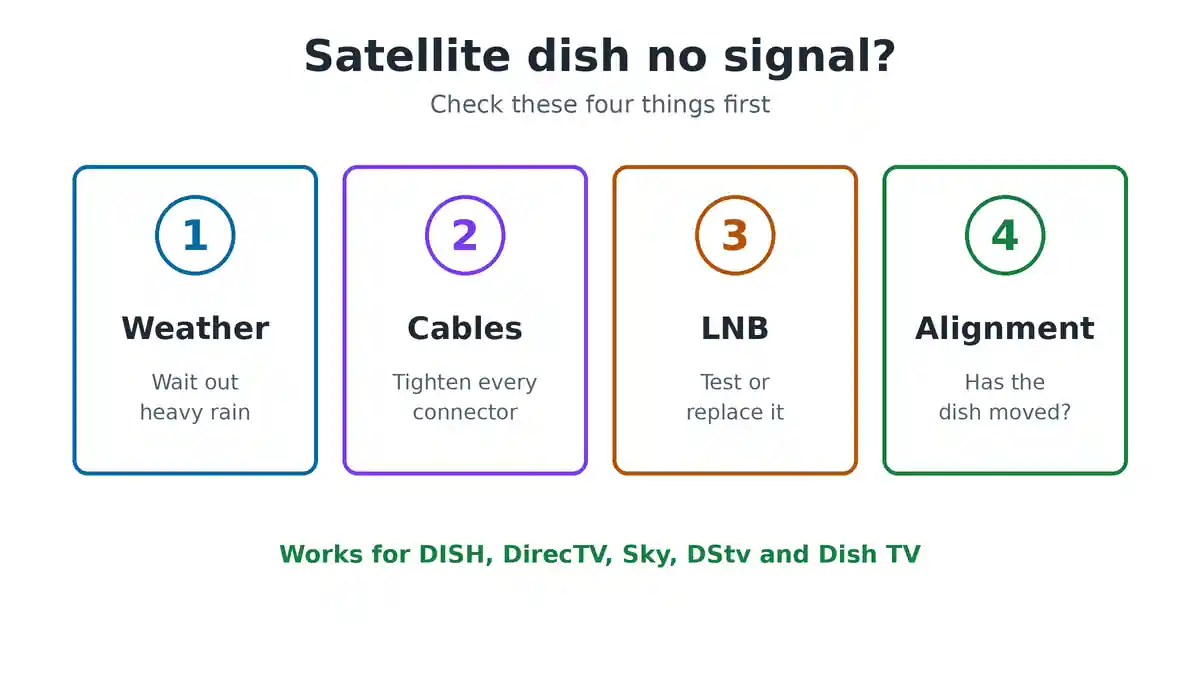
When your satellite dish has no signal, the cause is usually one of five things: bad weather, a loose cable, a faulty LNB, a dish that has moved, or something blocking its view of the sky. Most of these you can check yourself in under 30 minutes, without calling an installer.
This guide works for DISH Network and DirecTV in the US, Sky in the UK, DStv and StarTimes in Africa, and Dish TV, Tata Play and DD Free Dish in India. The steps are the same, because every satellite system works the same way.
First, Is It a Satellite Problem or a TV Problem?
Look at who is showing the message.
- The receiver shows the message inside its own menu or channel bar, for example “Searching for satellite signal”, “No satellite signal is being received” or “Signal not found”. That is a dish problem. Keep reading.
- The TV shows the message, usually “No Signal” or “No Input” in plain text. Then the dish is probably fine, and the fault is between the box and the TV. Follow our guide on how to fix no signal on TV instead.
Why Does My Satellite Dish Say No Signal?
A dish collects a weak signal from a satellite about 36,000 km above the equator. The LNB on the arm turns that signal into something your cable can carry to the receiver. If anything in that chain fails, you lose the picture.
| Cause | Typical sign |
|---|---|
| Heavy rain, snow or storm | Signal drops during bad weather, then returns |
| Loose or damaged cable | No signal on every channel, often after work in the house |
| Faulty LNB | No signal on all channels in clear weather |
| Dish moved by wind | Weak or no signal after a storm or strong wind |
| Something blocking the dish | Signal fades slowly over weeks as trees grow |
| Receiver fault or software glitch | Other receivers on the same dish still work |
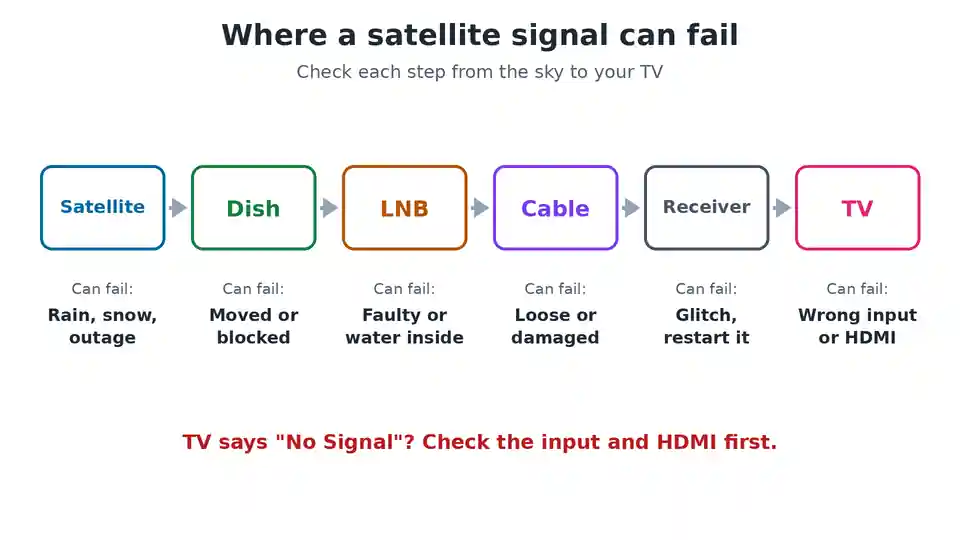
How to Fix a Satellite Dish With No Signal
Work through these fixes in order. Each one rules out a cause, so you will know what is wrong even if the last step is calling your provider.
1. Check the weather
Heavy rain, snow or thick storm clouds can block a satellite signal for a while. This is called rain fade. If the weather is bad, wait until it passes. The signal normally comes back on its own within an hour. Snow or ice packed on the dish face is different, because it stays after the storm. Clear it gently with a soft brush, never with hot water.
2. Restart the receiver
Switch the receiver off at the wall, wait one full minute, then switch it back on. Give it a few minutes to find the satellite. This clears software glitches, which cause more “no signal” messages than people expect. For DISH receivers, see our guide on how to hard reset a DISH Network receiver.
3. Check every cable connection
Follow the coaxial cable from the back of the receiver to the dish. Make sure it sits firmly in the socket marked SAT IN or LNB IN. Check any splitter, multiswitch or wall plate along the way. Look for kinks, cuts, chewed sections or connectors that have rusted outdoors. A single loose connector is enough to kill the signal.
If the cable is old or damaged, replace it with good quality satellite coaxial cable. Our guide on buying reliable coaxial cable for satellite TV explains what to look for.
4. Look at the signal strength screen
Most receivers have a signal screen in the settings or installation menu. It shows two bars, usually called signal strength and signal quality. Strength tells you something is reaching the receiver. Quality tells you whether it is the right, clean signal. Zero on both points to the cable or LNB. Some strength with poor quality points to alignment or weather.
5. Check what is blocking the dish
Stand behind the dish and look along the direction it points. The view to the sky must be completely clear. New tree branches, a new building, a parked truck or even a large sign can block the signal. Trim branches if you can do it safely, or move the dish to a clearer spot.
6. Check whether the dish has moved
Strong wind, a bird, a ball or someone leaning a ladder on the pole can knock a dish a few degrees out of line, and a few degrees is enough to lose the signal. Check that the mounting bolts are tight and the pole is not loose. If the dish has clearly shifted, realign it. Our guide on how to align a satellite dish without a meter walks you through it, or you can use a satellite finder meter for faster results.
7. Test or replace the LNB
If the weather is clear, the cables are fine and the dish has not moved, the LNB is the next suspect. LNBs fail with age, water getting in or a power surge. Look for cracks or water inside the cover. Swapping in a known working LNB is the quickest test. Follow our guide on how to fix the LNB on a satellite dish.
8. Try another receiver or TV point
If you have more than one receiver on the same dish, check whether the others work. When they do, the problem is in that one receiver or its cable, not the dish. When none of them work, the fault is at the dish, the LNB or the main cable.
9. Check for a provider outage
Sometimes the problem is not at your house at all. Providers occasionally have satellite or service problems. Check your provider’s app, website or social media pages, or ask a neighbour on the same service.
No Signal Messages by Provider
Each provider shows the problem in its own words. The fixes above still apply.
- DirecTV: “Searching for satellite signal”, often with error 771. Check the weather, cables and dish, then restart the receiver.
- DISH Network: “Acquiring signal” or a lost signal message. Restart the receiver, then run a check switch test from the settings menu on most models.
- Sky: “No satellite signal is being received”, error 25 or 29. See our guide to fixing Sky error 25 and 29.
- DStv: error E48-32 means no signal. Follow our steps to clear DStv error E48-32.
- Dish TV, Tata Play and DD Free Dish: “Signal not found” or “No signal”. Check the cable into the SAT IN socket, restart the box, then check the dish alignment.
Why Is There No Signal on Only One TV?
If one TV has no signal but the others work, the dish is fine. Check the cable to that room, the wall plate and the splitter or multiswitch port feeding it. Then restart that receiver. If it still fails, swap its cable with a working one to see whether the cable or the receiver is faulty.
How to Stop Losing Your Satellite Signal
- Use weatherproof F connectors and cover outdoor joints with self-amalgamating tape.
- Check the dish bolts once or twice a year, especially before the rainy or storm season.
- Keep trees trimmed back from the dish’s line of sight.
- Do not paint the dish or LNB, because some paints weaken the signal.
- Fit a surge protector, since lightning can damage both the LNB and the receiver.
For more ways to keep a strong picture, read our guide on how to boost TV signal for better reception.
When to Call an Installer
Call your provider or a qualified installer if the dish is on a high or steep roof, if the pole or bracket is damaged, or if you have checked everything above and still have no signal. Never climb onto a roof in wet or windy weather, and stay well away from power lines.
Common Questions
How long does rain fade last?
Usually only as long as the heaviest rain. The signal often returns within minutes to an hour once the storm moves on.
Can a satellite dish lose signal for no reason?
There is always a reason, but it is not always visible. A receiver glitch, a corroded connector or a slowly growing tree branch are easy to miss. Work through the checks in order.
How do I know if my LNB is bad?
If you get no signal in clear weather, the cables are fine and the dish has not moved, a bad LNB is the most likely cause. Swapping it for a working one confirms it.
Does the dish need to point at the sky?
It must point at one exact satellite position in the sky. In the northern hemisphere dishes generally face south, and in the southern hemisphere they generally face north, but the exact angle depends on your location and provider.
Fixing a Satellite Dish No Signal Problem
A satellite dish no signal message is usually fixed by waiting out bad weather, restarting the receiver, tightening a cable or clearing a blockage. If those do not work, check the dish alignment and the LNB, then contact your provider. To understand how weather affects satellite signals, see this explanation of rain fade.

Frenzy valentine is a passionate blogger, developer, and entrepreneur. He is the founder and author of myfreshgists.com.