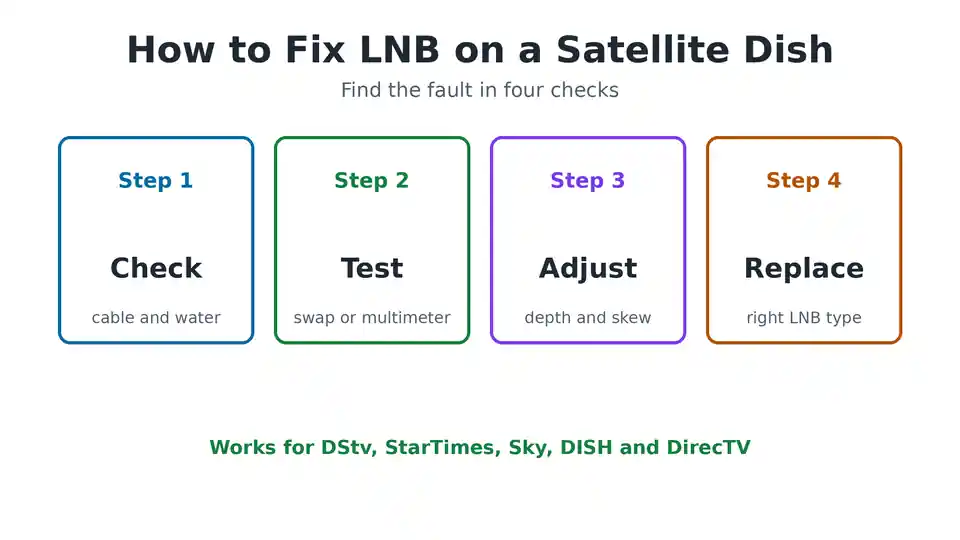
To fix LNB on satellite dish problems, start with the simple checks: a loose or wet cable connector, water inside the LNB cover, or an LNB that has slipped or turned in its holder. If those are fine, test the LNB by swapping it for one you know works. A faulty LNB cannot really be repaired, but it is cheap and easy to replace yourself.
This guide works for DStv, StarTimes and free to air dishes in Africa, Sky in the UK, and DISH or DirecTV in the US. You will learn what the LNB does, the signs that it is failing, how to test it, how to adjust it and how to replace it safely.
What Is an LNB on a Satellite Dish?
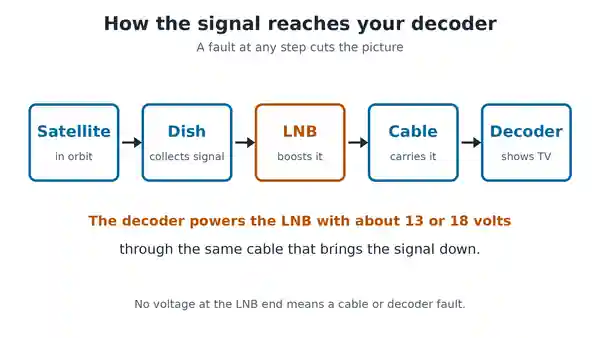
LNB stands for low noise block downconverter. It is the small unit at the end of the arm that sticks out in front of your dish. The dish collects the weak signal from the satellite and bounces it into the LNB. The LNB then boosts that signal and changes it to a lower frequency, so it can travel down the cable to your decoder or receiver.
Your decoder also powers the LNB through the same cable. It sends about 13 volts or 18 volts up the cable, and the voltage tells the LNB which group of channels to pick. So when the LNB or its cable fails, you usually lose every channel at once.
Where is the LNB on a satellite dish?
Look at the arm that comes out from the bottom or side of the dish. The LNB is the box or cylinder held in a clamp at the end of that arm, facing back into the dish. The cable from your decoder screws into the bottom of it. On an offset dish, which is the most common type, the arm comes from below, so the LNB sits a little under the centre of the dish.
What is a twin LNB?
A twin LNB has two cable outputs, so two receivers can use one dish, and each can watch a different channel. Quad LNBs have four outputs, and octo LNBs have eight. A monoblock LNB is different. It picks up two satellites that sit close together in the sky, not two receivers. If you add a second decoder, you need an LNB with one free output for each tuner.
Faulty LNB Symptoms: Signs You Need to Fix LNB on Satellite Dish
Bad LNBs show a few clear patterns. Match what you see to this table:
| What you see | Likely cause |
|---|---|
| No signal on every channel, even in dry weather | Dead LNB, broken cable or a decoder that no longer powers the LNB |
| Some channels work, others always show no signal | LNB fails on one polarity or one band, often a sign it is dying |
| Signal drops when it rains, then comes back days later | Water inside the LNB or the cable connector |
| Signal fades in the afternoon heat, returns in the evening | Ageing LNB with a heat fault |
| Good signal strength but quality near zero | Dish or LNB out of alignment, or the LNB is noisy |
| Picture breaks into blocks on all channels | Weak LNB, loose connector or a bad cable joint |
Heavy rain alone can also cut the signal for a short time. This is called rain fade. If the picture returns soon after the rain stops, your LNB is probably fine.
How to Test a Satellite LNB
You do not need special tools for the first two tests. Work through them in order.
1. Check the signal screen on your decoder
Open the decoder menu and find the signal or installation screen. On DStv, it is under Settings, then Signal. On StarTimes dish decoders and free to air receivers, it is in a similar menu. Note the strength and quality numbers. If both show zero, the decoder is not hearing the LNB at all. If strength is good but quality is low, the problem is more likely alignment than a dead LNB. Our guide on how to fix signal strength on DStv explains what good numbers look like.
2. Swap in an LNB you know works
This is the most reliable test. Borrow a working LNB of the same type from a neighbour or installer, and fit it in place of yours. If the signal comes back, your old LNB is faulty. If nothing changes, the fault is in the cable, the connectors, the dish alignment or the decoder.
3. Measure the LNB voltage with a multimeter
With the decoder switched on, unscrew the cable at the LNB end. Set a multimeter to DC volts. Touch one probe to the centre pin of the cable and the other to the metal outer part. You should see about 13 volts or about 18 volts.
If you see that, the decoder and cable are sending power, so the LNB is the suspect. If you see nothing, test at the decoder end. No voltage there means a decoder fault. Voltage at the decoder but not at the LNB means a broken cable. Do not let the centre pin touch the outer metal while the decoder is on, because a short can damage it. Our guide on using a multimeter on an antenna shows how to hold the probes.
4. Check the cable and connectors
Many “faulty LNB” problems are really bad cables. Look for green or white rust on the connector, a cable that has been crushed by a window or door, or a joint wrapped in tape. Cut off a corroded end and fit a new F connector. If the cable is old and cracked, replace the whole run. These tips for buying a reliable coaxial cable will help you pick a good one.
Can an LNB Be Repaired?
In practice, no. An LNB is a sealed unit with tiny circuits inside, and it is not built to be opened. Once the electronics fail, a repair costs more in time than a new LNB costs to buy. What you can fix are the problems around it:
- Water in the connector: dry it, fit a new F connector and seal it with self amalgamating tape or a rubber boot.
- A cracked or missing cover: replace the cover so rain cannot reach the circuit board.
- Insects or spider webs: clean the face of the LNB gently with a dry cloth.
- A loose clamp: put the LNB back in position and tighten the clamp.
If the LNB still fails after these, replace it.
How to Adjust LNB on Satellite Dish
Sometimes the LNB itself is fine, but it has slipped or turned in its holder. Strong wind, a ladder or a curious child can knock it. Here is how to set it right.
- Check the depth. The LNB must sit fully in its clamp, at the point the dish focuses the signal. Most holders have a stop or a mark. Push the LNB in to that point.
- Check the skew. Skew is how much the LNB is turned in its clamp. Most LNBs have a scale of degrees printed on the side. Your installer set this for your area, so look for an old scratch or mark and turn it back to that point.
- Turn slowly while someone watches the signal screen. Rotate the LNB a few degrees at a time. Stop at the point where the quality reading is highest.
- Tighten the clamp. Make it firm but do not crush the plastic body.
If the LNB position is right but the signal is still poor, the whole dish may have moved. The dish, not the LNB, must point at the satellite. In Nigeria, the DStv satellite sits to the east, so the dish faces roughly east and tilts up. Follow our guide on how to align a satellite dish without a meter for the steps.
How to Change LNB on Satellite Dish
Replacing an LNB takes about 20 minutes. Use a safe ladder and ask someone to hold it.
- Switch the decoder off at the wall. This stops the voltage on the cable while you work.
- Note the skew angle and depth of the old LNB. Take a photo with your phone.
- Unscrew the cable from the bottom of the LNB.
- Loosen the clamp and slide the old LNB out.
- Slide the new LNB in to the same depth, and turn it to the same skew angle.
- Tighten the clamp and screw the cable on firmly by hand.
- Seal the connector with self amalgamating tape or a rubber boot.
- Switch the decoder on and check the signal screen. Fine tune the skew if needed, then scan for channels.
If the decoder does not find channels after the change, run a channel scan. For DStv, our guide on how to fix DStv not scanning covers the installation wizard.
Which LNB Should You Buy to Fix LNB on Satellite Dish?
Buy the type your service uses. LNBs are not all the same, and the wrong one can give no signal at all.
- DStv, StarTimes dish and free to air in Africa: a universal Ku band LNB works for most single decoders. Pick a twin LNB if you have two decoders or a twin tuner box.
- DStv Explora: many Explora setups use a DStv Smart LNB, which lets one cable serve several tuners. Replace a Smart LNB with another Smart LNB, not a basic universal one, or you may lose signal and recording.
- Sky in the UK: Sky Q needs a wideband LNB. Older Sky boxes use a quad or octo LNB.
- DISH and DirecTV in the US: both use their own LNBs, which ordinary universal LNBs cannot replace. Contact your provider, because equipment is often covered for active customers.
Avoid the cheapest unbranded LNBs. They often fail after a short time in strong sun and heavy rain.
When the LNB Is Not the Problem
If a working LNB and a good cable do not bring the signal back, look elsewhere:
- Something blocks the view. A new building, tree branches or a water tank in front of the dish can cut the signal.
- The dish is bent or loose. A dented dish cannot focus the signal on the LNB.
- The decoder is faulty. If it gives no voltage at its own socket, it needs repair or replacement.
- It is a subscription problem. A message like “please subscribe” or E16 is not a signal fault at all.
For a full list of causes, read our guide on what to do when your satellite dish says no signal. If you have DStv and see E48-32, see how to clear DStv error E48-32.
Common Questions
How long does an LNB last?
A good LNB often lasts many years. Heat, rain and lightning shorten its life. If yours is old and signal problems keep coming back, a new one is worth trying.
Can a bad LNB damage my decoder?
A shorted LNB or cable can strain the power circuit that feeds the LNB. Many decoders protect themselves and show an LNB short or overload message. Fix the short before you use the decoder again.
Why do some channels work and others do not?
Channels are split into groups by polarity and band. If the LNB fails on one group, only those channels go off. This often happens just before an LNB dies completely.
Does the LNB need to point south?
No. The LNB always faces back into its own dish. It is the dish that points at the satellite, and the direction depends on where you live and which satellite you use.
Fix LNB on Satellite Dish Problems Step by Step
To fix LNB on satellite dish faults, check the simple things first: dry, tight connectors, a sealed cover and the right depth and skew. Then test by swapping in a working LNB or measuring the voltage. If the LNB is faulty, replace it with the right type for your service, seal the connector and rescan. For more technical background, see this overview of the low noise block downconverter.

Frenzy valentine is a passionate blogger, developer, and entrepreneur. He is the founder and author of myfreshgists.com.
LNB is old making signal breakage so I changed it but still the visuals are the same