Last updated: April 2026
You are settled in, ready to watch your favourite show, and then it happens — your screen goes blank or displays the dreaded E48-32 error. The frustration is real, especially when it seems to come out of nowhere. The good news is that this is one of the most common DStv errors reported across the continent, and in the vast majority of cases, you can fix it yourself in under 30 minutes without calling a technician.
This guide walks you through every possible cause of the E48-32 error and the no-signal problem, gives you clear, step-by-step solutions in plain language, and helps you prevent the issue from coming back. Whether you are using a DStv HD decoder, an Explora, or an Extra View setup, this guide covers you. Let us get your DStv working again.
What Is the DStv E48-32 Error?
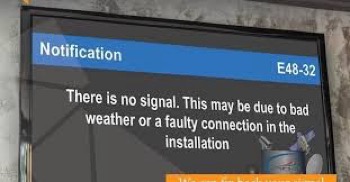
The E48-32 error is a signal-related error code that appears on your TV screen when your DStv decoder is unable to receive a proper signal from the satellite. The full message usually reads something like: “No Signal — E48-32 — Your decoder is not receiving a satellite signal.”
This error is different from a subscription or payment error. It has nothing to do with your account balance or package status. It is purely a technical, signal-reception issue that sits somewhere between the satellite dish on your roof and the decoder sitting in your living room. The problem could be at the dish itself, in the cables connecting the dish to your decoder, or inside the decoder — and this guide will help you pinpoint exactly where.
It is also worth noting that the E48-32 code is specifically a no-satellite-signal code. A separate but related experience is when your TV simply shows “No Signal” — this is usually a different problem involving the HDMI or AV connection between your decoder and your TV, rather than the satellite dish. We will cover both scenarios in this guide so you have everything you need in one place.
What Causes the E48-32 Error on DStv?
Before you start pressing buttons and moving things around, it helps to understand why this error occurs. The satellite signal travels from a DStv satellite in orbit, hits your dish, travels down the LNB cable into your decoder, and then gets decoded into the picture on your screen. Any disruption anywhere along that chain can trigger the E48-32 error. Here are the most common culprits:
1. Bad Weather and Atmospheric Conditions
This is by far the most frequent cause. Heavy rain, thick cloud cover, thunderstorms, and even very strong winds can temporarily weaken or completely block the satellite signal. The technical term for this is rain fade. Satellite signals operate on a frequency that gets absorbed by water droplets in the atmosphere, so during heavy downpours the signal can drop significantly. The error will usually clear on its own once the weather improves, but there are steps you can take to minimise weather-related disruptions going forward.
2. Misaligned Satellite Dish
Your dish must be precisely aimed at the DStv satellite. Even a shift of a few degrees can cause signal loss. Dishes can be knocked out of alignment by strong winds, physical impact (a ball hitting it, someone brushing past it), or simply settling of the wall or pole it is mounted on over time. If your signal was perfectly fine and then suddenly dropped with no obvious weather explanation, a misaligned dish is high on the list of suspects.
3. Faulty or Damaged LNB
The LNB (Low Noise Block downconverter) is the small component that sticks out at the front of your dish. It is the device that actually collects the satellite signal and sends it down the cable to your decoder. LNBs can fail due to lightning strikes nearby, water ingress, manufacturing faults, or simply old age. A dead or dying LNB is one of the most common hardware causes of the E48-32 error. Signs of a failing LNB include intermittent signal loss, signal that disappears and reappears, or a complete E48-32 with no signal at all.
4. Damaged or Poorly Connected Coaxial Cables
The coaxial cable that runs from your LNB down to your decoder is the signal highway. If this cable is damaged — whether cut, kinked, corroded at the connectors, or chewed through by animals — the signal will not get through properly. This is a surprisingly common issue, especially with outdoor cable runs exposed to UV light and weather over many years. The connectors at each end of the cable are also frequent failure points; if they are loose or oxidised, signal loss is inevitable.
5. Obstructions in the Dish’s Line of Sight
Trees grow. Buildings go up. Extensions get added to houses. If something has grown or been built in the path between your dish and the sky — particularly in the direction the dish is pointing — it will block or degrade the signal. Overhanging branches are a very common seasonal problem; a tree that was fine during dry season might suddenly have thick new growth blocking the dish during the rains.
6. Dirty or Dusty Smart Card
The smart card inside your DStv decoder is the card that tells the system your subscription details and unlocks your channels. Dust and grime can accumulate on the gold contacts of the smart card over time, causing poor contact and triggering error codes including E48-32. This is a simple fix that many people overlook.
7. Decoder Software Glitch
Like any piece of electronic equipment, your DStv decoder runs on software. Occasionally, this software can encounter a glitch or get stuck in an error state — especially after power cuts or voltage spikes. A simple restart or reset can often clear these software-level errors immediately.
8. Power Supply Issues
Inconsistent power supply — which is a reality in many parts of Africa — can damage decoders and LNBs. Voltage fluctuations and power surges can corrupt the decoder’s internal processes or damage the LNB. If the E48-32 error appeared right after a power cut or a lightning storm, there is a chance that electrical damage has occurred somewhere in your setup.
9. Dish Not Properly Secured
Over time, the bolts and brackets holding your dish to the wall or pole can loosen, especially in areas with frequent strong winds. A loose dish will shift slightly in the wind and cause intermittent signal loss — you might notice signal cutting in and out during windy conditions even without rain.
10. Extra View / Multi-Decoder Setup Issues
If you are running an Extra View setup with two or more decoders linked together, the E48-32 error can also be caused by incorrect connection between the primary and secondary decoders, a faulty Multi-Switch, or a secondary LNB that has failed. These setups have more components and therefore more potential points of failure.
Step-by-Step Fixes for DStv E48-32 Error
Work through these fixes in order. Start with the simplest ones — they solve the problem the majority of the time — and only move on to the more involved steps if the earlier ones do not work.
Step 1: Check the Weather First
Before you do anything else, look outside. Is it raining heavily? Is there a thunderstorm? Is the sky full of thick, dark clouds? If yes, there is a very good chance the error is simply weather-related rain fade, and the signal will come back by itself once the weather clears. In that situation, the best thing you can do is wait it out. There is nothing wrong with your equipment — the signal is just temporarily blocked by atmospheric conditions.
If the weather is clear, move on to the next step.
Step 2: Restart Your Decoder
This sounds almost too simple, but it resolves a surprising number of E48-32 errors caused by software glitches. Here is how to do it properly:
- Press the power button on your remote to turn the decoder off. Do not just put it on standby — turn it fully off using the button on the decoder itself if needed.
- Once the decoder is off, unplug the power cable from the wall socket completely. Do not just switch off the wall switch — physically remove the plug from the socket.
- Wait for a full 60 seconds. This is longer than most people wait, but it gives the decoder’s internal capacitors time to fully discharge and the software to completely reset.
- Plug the power cable back in and switch on at the wall.
- Press the power button on your decoder to turn it on, and wait for it to fully boot up. This can take up to two minutes.
- Check if the error has cleared.
If the error is gone, great — you are done. If it is still showing, continue to Step 3.
Step 3: Clean Your Smart Card
The smart card is the small, credit-card-sized card inserted into the slot on the front of your decoder. Dust and oxidation on its gold contacts can cause signal and authentication errors. Here is how to clean it safely:
- Turn off and unplug your decoder first.
- Locate the smart card slot — it is usually on the front panel of the decoder.
- Gently slide the smart card out. Note which way it was inserted (there is usually an arrow indicating direction).
- Take a clean, dry, lint-free cloth or a pencil eraser and gently rub the gold contact strips on the card. You want to remove any tarnish or residue without scratching the contacts.
- If you have a can of compressed air, blow out the card slot to remove any dust inside.
- Reinsert the card firmly in the correct orientation. You should feel or hear a slight click when it is properly seated.
- Plug the decoder back in, turn it on, and check for the error.
Step 4: Check All Cable Connections
A loose or damaged cable is one of the most common physical causes of signal loss. You need to check every connection point in the cable run from the dish to your decoder.
- At the decoder: Look at the coaxial cable plugging into the back of your decoder (labelled “LNB IN” or “DISH IN”). Make sure it is screwed in firmly. Wiggle it gently — if the signal flickers when you touch it, that connector is your problem.
- Along the cable run: Trace the coaxial cable from the decoder out through the wall and as far as you can see. Look for any visible damage — cuts, crimps, sections that have been flattened or bent sharply, or sections that animals may have chewed through.
- At any wall plates or junction boxes: If your cable goes through a wall plate or splitter, check those connection points too.
- At the LNB: If you can safely access the dish, check where the cable connects to the LNB. This connection is exposed to the weather and is a common point of corrosion and failure. The connector should be firm and ideally weatherproofed with waterproof tape.
If you find a loose connector, tighten it. If the cable itself is damaged, it will need to be replaced. You can buy coaxial cable and F-connectors at most hardware and electronics shops, but if you are not comfortable with the work, call a technician for this step.
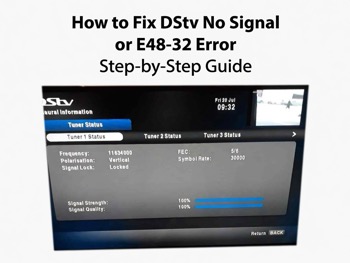
Step 5: Check the Signal Strength in the Decoder Menu
Your DStv decoder has a built-in signal strength meter that tells you exactly how much satellite signal is coming in. This is a very useful diagnostic tool. Here is how to access it:
- Press the Menu button on your DStv remote.
- Navigate to Advanced Options (on some decoders this may be under Settings or Installation).
- Select Dish Installation or Signal Detection.
- You will see a signal strength bar and a signal quality bar.
For good reception, you generally want your signal strength to be above 50% and your signal quality to be above 60%. If both bars are at zero, the decoder is receiving absolutely nothing from the dish — this points strongly to an LNB fault, a completely disconnected cable, or a severely misaligned dish. If you see some signal but it is very low, the dish may be slightly off-alignment or there may be a partial obstruction.
Keep this screen open while you move on to the next steps — it will help you see in real time whether your adjustments are making a difference.
Step 6: Inspect Your Satellite Dish for Obstructions
Go outside and look at your satellite dish. Check for:
- Tree branches — especially new growth that may have extended into the signal path since the dish was first installed. Even leaves fluttering in front of the dish can cause signal degradation.
- Bird nests — birds sometimes build nests on or inside the dish, and even a small nest in the wrong spot can block the signal.
- Accumulated debris — leaves, dust, dried mud, or other material sitting in the dish bowl. A light coating is usually not a problem, but heavy debris can affect reception. Clean the dish gently with a soft brush if needed.
- New structures — has a new wall, extension, water tank, or other structure gone up near the dish since it was installed? Even something on a neighbouring property could be the culprit.
Remove any debris or branches you find, then go back and check your signal meter to see if things have improved.
Step 7: Check the Dish Alignment
If the signal meter is showing zero or very low signal and you have ruled out obstructions, the dish may have shifted out of alignment. Re-aligning a satellite dish is a task that requires some patience, but it is doable if you are careful.
Important safety note: Only attempt this if the dish is mounted at a safe, accessible height. Never climb onto an unstable surface or work near electrical lines. If the dish is on a roof and you are not comfortable with heights, call a technician.
- Have a helper watch the signal meter on the TV inside (or use a second phone to video call them so they can relay readings to you).
- Loosen — but do not remove — the bolts holding the dish to its mount. You need the dish to be movable but not so loose it swings freely.
- Very slowly rotate the dish horizontally (left and right — this is called adjusting the azimuth) in small increments. After each small movement, pause for a few seconds and have your helper check if the signal meter has moved.
- When you find a direction that gives you the best signal, start making small vertical adjustments (tilting the dish up and down — this is called adjusting the elevation).
- The goal is to find the sweet spot where both signal strength and signal quality are maximised. Once you find it, tighten the bolts firmly while holding the dish in that position.
- Double-check that the bolts are all fully tightened before leaving the dish.
This process takes patience. Make very small adjustments and wait a few seconds between each one. The satellite is very far away, and even a tiny movement of the dish translates to a large shift in where it is pointing in the sky.
Step 8: Test and Replace the LNB
If the signal meter shows zero even with the dish well-aligned and the cable connections all checked, there is a strong chance the LNB has failed. The LNB sits at the end of the arm sticking out from the front of the dish. Here is how to test it:
- If you have a friend or neighbour with a working DStv setup using a similar dish and LNB type, ask to borrow their LNB briefly to test it on your dish. If swapping in their LNB brings the signal back, you have confirmed yours is faulty.
- Alternatively, look at the LNB itself. Signs of physical damage include cracking, water inside the casing, a burnt smell, or visible rust or corrosion at the cable connection point.
- LNBs are not expensive — depending on your country and the type of LNB you need (single, dual, or quad output), they typically cost the equivalent of a few US dollars to a modest amount at electronics shops. Replacing an LNB is straightforward: the LNB simply screws or clips onto the arm of the dish, and the coaxial cable connects to it with an F-connector.
If you are replacing the LNB yourself, make sure you buy the correct type for your setup. An Extra View or multi-room setup requires a dual-output or quad-output LNB, not a single-output one.
Step 9: Factory Reset Your Decoder (Last Resort Before Calling Support)
If you have tried everything above and the error persists, a factory reset of the decoder can sometimes resolve deep software issues. Be aware that a factory reset will erase all your personal settings, recordings scheduled, and parental control PINs — so only do this as a last resort.
The method for performing a factory reset varies slightly by decoder model:
- DStv HD Decoder: Go to Menu → Advanced Options → Factory Reset. You will be prompted to enter your PIN (default is 0000 if you have never changed it). Confirm the reset and wait for the decoder to restart.
- DStv Explora: Go to Menu → Settings → Advanced → Factory Reset. Follow the on-screen prompts.
- DStv Explora Ultra: The reset option is under Menu → Settings → System → Reset.
After the reset, the decoder will go through its startup and self-installation process. Follow the on-screen prompts to complete the setup. If you had a valid signal before the reset, it should be detected automatically during this process.
Step 10: Contact DStv Support
If you have worked through all the steps above and you are still seeing the E48-32 error, it is time to get professional help. You can contact DStv customer care via their official self-service portal, where you can log a fault, chat with a support agent, or book a technician visit. DStv also has customer care lines in all its operating countries. When you call, explain that you have already tried restarting the decoder, checking the cables, cleaning the smart card, and checking the signal meter — this will help the agent understand the situation faster and escalate appropriately.
DStv E48-32 Troubleshooting Flowchart
Use this quick-reference flowchart to work through the problem systematically:
START → Is it raining or stormy outside?
→ YES: Wait for weather to clear. Signal should return. If it doesn’t, continue below.
→ NO: Continue.
→ Does restarting the decoder (fully unplugged for 60 seconds) fix the error?
→ YES: Done. Monitor for recurrence.
→ NO: Continue.
→ Is the signal meter showing any signal at all (Menu → Advanced → Dish Installation)?
→ ZERO signal: Likely LNB failure, disconnected cable, or severely misaligned dish. Jump to Steps 4, 7, and 8.
→ LOW signal: Possible misalignment, obstruction, or weak cable connection. Go to Steps 5 and 6.
→ Are all cable connections firm and the cable undamaged?
→ NO: Fix or replace cables. Recheck signal.
→ YES: Continue.
→ Is the dish obstructed by trees, structures, or debris?
→ YES: Clear obstruction. Recheck signal.
→ NO: Continue.
→ Has the dish physically moved or shifted?
→ YES: Realign dish carefully. Recheck signal.
→ NO: Continue.
→ Is the LNB visibly damaged or suspected faulty?
→ YES: Replace LNB. Recheck signal.
→ NO: Try factory reset. If still failing, contact DStv support.
Special Cases: Extra View and Multi-Room Setups
If you are running an Extra View setup — where two or more decoders are connected and linked to the same subscription — the E48-32 error can present in some unique ways. Here is what to check specifically for these setups:
Is only one decoder showing the error? If your primary decoder is fine but your secondary decoder is showing E48-32, the problem is likely in the secondary decoder’s cable connection or in the Multi-Switch (also called an LNB switch or multiswitch) that distributes the signal to multiple decoders. Check the cable running to the affected decoder and the switch connections.
Are both decoders showing the error at the same time? This points to a problem higher up the chain — either the LNB itself, the main coaxial cable from the dish, or a problem with the dish alignment. Treat it the same as a single-decoder setup and work through Steps 1–9 above.
Extra View link errors: Sometimes the E48-32 error on a secondary Explora in an Extra View setup can be caused by the UHF or network link between the two decoders being disrupted, rather than a true satellite signal problem. Try re-linking the decoders through the Extra View setup menu on your primary decoder.
Dual or Quad LNB requirement: An Extra View setup requires a dual-output or quad-output LNB to supply signal to multiple decoders simultaneously. If someone replaced the LNB with a single-output model, the secondary decoder will have no signal. Verify that your LNB has the correct number of outputs for your setup.
What “No Signal” on Your TV Screen Means (And How It Differs From E48-32)
It is important to distinguish between two different “no signal” situations, because the fix is completely different for each:
Situation A: Your TV shows “No Signal” but the decoder appears to be on. This is not an E48-32 error — this is a connection problem between your decoder and your TV. The satellite signal may be perfectly fine, but the decoder’s output is not reaching the screen. Check your HDMI cable (or AV cable if you are using the older red/yellow/white connectors). Try unplugging the HDMI cable from both ends and firmly plugging it back in. Try a different HDMI port on your TV. If possible, try a different HDMI cable altogether. Also check that your TV is set to the correct input/source — press the Source or Input button on your TV remote and select the HDMI port your decoder is connected to.
Situation B: Your decoder screen shows E48-32. This is the satellite signal error covered throughout this guide. The issue is between the dish and the decoder, not between the decoder and the TV.
Mixing up these two situations can lead to a lot of unnecessary troubleshooting in the wrong direction, so always identify which situation you are in before you start fixing things.
Common Mistakes People Make When Trying to Fix This Error
Having walked through the correct steps, it is just as useful to know what not to do. Here are the most common mistakes that either make the problem worse or waste a lot of time:
Mistake 1: Only Pressing Standby Instead of Fully Restarting
Putting the decoder on standby with the remote does not fully reset the system. For a proper restart, the decoder needs to be completely powered off and unplugged from the wall. Many people press the standby button, wait a few seconds, turn it back on, and then conclude that “restarting didn’t work” — when they have not actually fully restarted it at all.
Mistake 2: Repeatedly Removing and Reinserting the Smart Card
While cleaning the smart card is good, repeatedly pulling it in and out many times can damage the card reader mechanism inside the decoder. Do it once, clean properly, reinsert, and give it a chance to work before trying again.
Mistake 3: Moving the Dish Without a Signal Meter
If you try to realign the dish by guessing or by eye, without watching the signal strength meter in real time, you are very likely to make things worse. The dish needs to be moved in tiny increments with constant feedback from the signal meter. Always have someone watching the meter while you adjust the dish.
Mistake 4: Assuming the Problem Is an Unpaid Subscription
E48-32 is not a payment or subscription error. If your subscription has lapsed, you will get a different error code (typically E16-4 or similar). Do not waste time topping up your account to fix E48-32 — it will not help.
Mistake 5: Ignoring the Cable Connections
Cable connections are one of the most common physical causes of E48-32, but many people go straight to thinking the dish or LNB is faulty without checking the cables first. Always check the cables — it is quick, costs nothing, and solves the problem more often than you would expect.
Mistake 6: Doing a Factory Reset Before Checking Hardware
A factory reset cannot fix a physical problem like a broken LNB or damaged cable. If you do a reset and it does not work, you have now lost all your settings and recordings for no benefit. Always exhaust the physical checks before resorting to a factory reset.
Mistake 7: Attempting DIY Dish Work in Dangerous Conditions
Never climb up to adjust a dish during a storm, on a wet roof, or in any unsafe conditions. It is not worth the risk. Wait for safe conditions or call a professional.
How to Prevent DStv E48-32 Errors in the Future
Once you have fixed the error, take these steps to reduce the chances of it coming back:
Install a Surge Protector
Power surges are one of the leading killers of decoders and LNBs. A good quality surge protector (not just a basic extension lead, but one with genuine surge suppression) plugged between the wall socket and your decoder can save you from costly replacements. This is a worthwhile investment, especially in areas with frequent load shedding or unstable power supply.
Weatherproof Your Cable Connections
The connection point where the coaxial cable meets the LNB is exposed to the elements and is a common site of corrosion and water damage. Ask your installer to apply self-amalgamating (self-sealing) waterproof tape over this connection. It costs almost nothing and dramatically extends the life of the connection.
Trim Overhanging Trees Regularly
If you have trees near your dish, make a habit of checking once or twice a year — particularly before the rainy season — that no new growth is encroaching on the signal path. A quick trim can prevent months of frustrating signal problems.
Tighten the Dish Mounting Bolts Annually
Metal expands and contracts with temperature changes, and wind vibration can work bolts loose over time. Once a year, when it is safe to do so, check that all the bolts securing your dish to its mount are still fully tight. This takes five minutes and can prevent misalignment problems.
Keep the Decoder in a Well-Ventilated Location
Your decoder generates heat during operation and needs airflow to stay cool. Do not place it in an enclosed cabinet without ventilation, do not stack other equipment directly on top of it, and make sure the vents on the sides and back are not blocked. Overheating can cause intermittent errors and shorten the life of the decoder.
Clean the Smart Card Slot Every Six Months
Dust is inevitable. Making a habit of gently cleaning your smart card and its slot every six months is a simple maintenance step that can prevent error codes caused by poor card contact.
Use Quality Coaxial Cable
If you ever need to replace or extend your coaxial cable, invest in good quality RG-6 coaxial cable rather than the cheapest option available. RG-6 has better shielding and handles signal over longer runs much more effectively than the thinner, cheaper RG-59. The difference in cost is small, but the difference in signal quality can be significant.
Frequently Asked Questions About DStv E48-32 Error
Q1: How long does the E48-32 error last?
If the cause is bad weather (rain fade), the error will typically last only as long as the heavy rain or storms. Once the weather clears, the signal usually returns within a few minutes. If the cause is a hardware or alignment issue, the error will persist until you fix the underlying problem — it will not go away on its own in those cases.
Q2: Is E48-32 a subscription or payment problem?
No, not at all. The E48-32 error is a satellite signal error, not an account or billing error. Topping up your account or renewing your subscription will not fix this error. If your account has expired, you will typically see a different error code, and the message will specifically mention account or subscription status.
Q3: Can I fix E48-32 without a technician?
Yes, in the majority of cases. Most instances of E48-32 are caused by weather, loose cables, dirty smart cards, or minor software glitches — all of which you can fix yourself by following the steps in this guide. You only need a technician if there is a confirmed hardware failure (such as a broken LNB or damaged dish mount) that you cannot safely or practically address yourself.
Q4: Why does the error keep coming back?
If the error keeps returning, it usually means the underlying cause has not been fully resolved. Common culprits for recurring E48-32 include: a cable that is intermittently losing connection (not fully tightened or internally damaged), an LNB that is failing gradually rather than all at once, a dish that was not properly re-tightened after realignment and keeps shifting in the wind, or trees that are continuing to grow into the signal path. Recurring errors deserve a more thorough investigation than a one-time error.
Q5: Does E48-32 affect all channels or just some?
E48-32 is a general signal error that typically affects all channels simultaneously, since all DStv channels come through the same satellite signal path. If you are losing signal on only specific channels but others are working fine, that is more likely to be a transponder issue or an account/package issue rather than a true E48-32 signal problem.
Q6: What should the signal strength and quality percentages be?
For stable, reliable viewing, most DStv decoders perform well when signal strength is between 60% and 90%, and signal quality is above 60%. If your signal quality drops below 40%, you are likely to experience freezing and errors during heavy rain. If it drops to zero, you will see E48-32. Note that signal strength and signal quality are two different readings — quality is actually more important for picture stability than raw strength.
Q7: My decoder says 100% BE2 instead of 100% MAC — what does that mean?
This is a specific boot-up display issue seen on some decoder models. “BE2” and “MAC” refer to different stages of the decoder’s boot-up process. If your decoder is stuck displaying “100% BE2” and not progressing to “100% MAC,” it may be frozen mid-boot. Try a full power cycle (unplug completely, wait 60 seconds, plug back in). If it continues to get stuck, this may indicate a software fault that requires a factory reset or a visit from a DStv technician.
Q8: Why did I suddenly get E48-32 with no weather or obvious reason?
Sudden E48-32 with no apparent cause is usually traced to one of three things: a cable connection that worked loose (perhaps from vibration or temperature-related expansion and contraction), an LNB that has abruptly failed (they can fail suddenly with no warning), or a software glitch in the decoder that needs a restart to clear. Start with a full restart, then check the cable connections, then suspect the LNB if those do not help.
Q9: Can a lightning storm cause permanent damage that triggers E48-32?
Yes. Lightning does not have to strike the dish directly to cause damage. A nearby strike can send a surge through the ground or through the electrical system that travels back up the coaxial cable and destroys the LNB or the decoder’s tuner. If you experienced a lightning storm and E48-32 appeared immediately after, there is a strong chance of lightning-related damage. Check the LNB first (it is more commonly damaged than the decoder in these situations), and if it needs replacement, consider also fitting a coaxial surge protector on the cable between the dish and the decoder to prevent future damage.
Q10: How do I know if my LNB needs to be replaced?
Signs that your LNB has failed or is failing include: signal meter showing zero even with the dish properly aligned and cables intact; signal that drops completely during rain but completely disappears even in fair weather; intermittent signal loss that does not correspond to weather conditions; visible physical damage to the LNB housing (cracking, water inside, burn marks, heavy corrosion). The definitive test is to try a known-working LNB on your dish — if the signal returns, your original LNB was the problem.
Q11: Is there a DStv app I can use when the decoder has E48-32?
Yes. If your internet connection is working, you can use the DStv Stream app (available on smartphones, tablets, and smart TVs) to continue watching your subscribed channels over the internet while you work on fixing the dish signal issue. This is a great way to keep your family watching their favourite programmes without interruption while you troubleshoot. Note that streaming over the app uses data from your internet connection, so be mindful of data costs if you are on a capped plan.
Q12: My Extra View secondary decoder shows E48-32 but the primary is fine — why?
In an Extra View setup, each decoder needs its own signal feed. If the primary is working but the secondary is not, the problem is specific to the secondary decoder’s signal path. Check the cable running to the secondary decoder, the connection at the LNB switch (multiswitch) that feeds the secondary, and the F-connector at the back of the secondary decoder. Also confirm that your LNB is a dual-output or quad-output model — a single-output LNB cannot feed two decoders simultaneously.
Q13: How do I contact DStv support if I cannot fix the error myself?
You can reach DStv customer support through the official DStv self-service portal online, through the MyDStv app, or by calling your country’s DStv helpline. In South Africa the call centre number is widely available on the DStv website; in Nigeria, Kenya, and other African countries, DStv maintains country-specific support lines. When you call, note your decoder’s model number and your smart card number (printed on the card), as you will be asked for these. You can also visit a DStv-accredited walk-in service centre in your city.
Q14: Can I realign the dish myself or do I need a professional?
Many people successfully realign their own dish using the signal meter in the decoder menu as a guide. However, it requires patience, safe access to the dish, and ideally a second person to relay signal readings. If your dish is on a high roof, mounted in a difficult location, or if you are not comfortable working at height, it is safer and often cheaper in the long run to have a qualified DStv-accredited installer do the alignment. A professional installer will have a dedicated satellite signal meter that gives far more precise readings than the decoder’s built-in meter, making the process faster and more accurate.
Final Thoughts
The DStv E48-32 error might feel alarming when it first appears, but in most cases it is a solvable problem that does not require replacing your entire setup or spending a lot of money. The key is to approach it methodically: start with the simplest possible causes (weather and a proper restart), work through the physical checks (cables, smart card, obstructions), investigate the dish alignment and LNB if needed, and only escalate to professional support when you have genuinely exhausted the self-help options.
Taking the prevention steps outlined in this guide — surge protection, weatherproofing cable connections, trimming trees, and regular maintenance — can significantly reduce how often you encounter this error in the future. A little maintenance goes a long way with satellite TV equipment.
If you found this guide helpful, you might also want to read our article on how to make your DStv payment online to keep your subscription active and avoid account-related errors alongside signal issues. And if you ever need to explore your full DStv account settings or book a technician, the official DStv self-service portal is the best starting point for getting help directly from the provider.
Good luck, and here’s to uninterrupted viewing!

Frenzy valentine is a passionate blogger, developer, and entrepreneur. He is the founder and author of myfreshgists.com.
Not happy with error 48_32 may you tell us what to do on extra view
Having problems with my extra view error 48_32 what should I do
Extraview connection is having error 48_32 what should I do
I haven’t been able to watch TV for the past week
Devoder displaying 100% be2 not 100%mac
Decoler have an error in booting showing 100% be2 instead of 100% mac