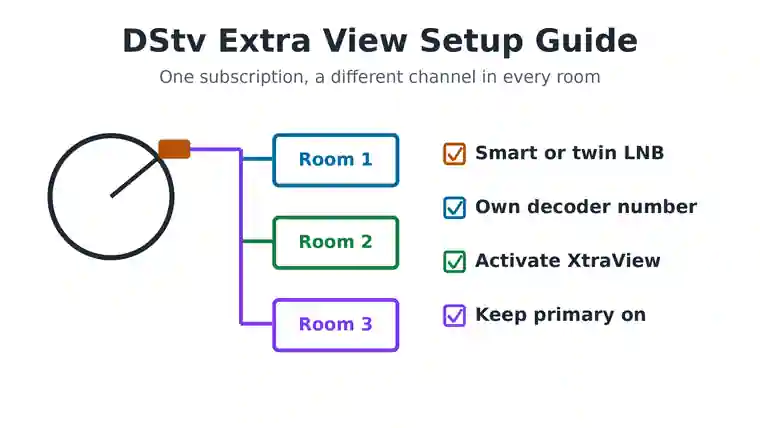
DStv Extra View, now called XtraView, lets two or three DStv decoders share one subscription, so each room can watch a different channel. You want DStv in more than one room, but before you buy cables or book an installer, answer one question: should every TV show the same channel, or should each room watch something different? The first needs only your current decoder. The second needs DStv Extra View, and the two setups differ completely in cost.
Below you will find both setups, starting with the cheaper one. Then comes how XtraView works, what to buy, how the cables connect, and how to clear the common errors.
On This Page
- Same channel or different channels?
- Option 1: One decoder, several TVs, same channel
- Option 2: DStv Extra View (XtraView)
- What you need for DStv Extra View
- How to connect the Extra View cables
- Extra View with a diplexer
- DStv Extra View settings on the decoder
- Extra View setup and activation step by step
- Extra View problems and fixes
- Common questions
Same Channel or Different Channels?
If every TV can show the same channel at the same time, you only need one decoder and a way to send its picture to the other TVs. There is no extra monthly fee. If each room needs a different channel, you need DStv Extra View, which links extra decoders to one subscription for a monthly access fee.
Think about how your home actually watches TV. A shop, a bar or a family that watches together is usually happy with the same channel everywhere. A home where the children want cartoons while someone else watches football needs Extra View.
Option 1: One Decoder, Several TVs, Same Channel
One decoder can feed several TVs, but all of them show whatever channel the decoder is on. You change the channel from the room with the decoder. This costs no monthly fee, only the cables and a splitter.
Using HDMI
Most current DStv decoders connect to the TV by HDMI. To send the picture to a second TV, use an HDMI splitter. It takes one HDMI input from the decoder and sends it to two or more TVs.
The same idea works for GOtv, and our guide on how to connect two TVs to one GOtv decoder shows the cables step by step.
HDMI cables lose signal over long distances. For a TV in another room, use an HDMI extender instead, which sends the picture over a network cable. A good extender carries the picture much further than a plain HDMI cable.
Using the RF output on older decoders

Some older DStv decoders have an RF OUT socket. It sends the picture down a coaxial cable to a TV’s aerial input, where the TV tunes to it like a channel.
- Connect coaxial cable from the decoder’s RF OUT to the TV’s aerial input.
- For two or more TVs, put a splitter on the cable, with one output for each TV.
- On each TV, run a channel scan so it finds the decoder’s signal.
Long cable runs and every extra splitter weaken the picture. So keep cables as short as you can, and use good RG6 cable with properly fitted F connectors. Our guide to choosing coaxial cable for satellite TV explains what to buy.
The remote control problem
The DStv remote works by infrared, so it must point at the decoder. Someone in another room cannot change the channel. If that matters, Extra View is the better choice.
Option 2: DStv Extra View (XtraView)
DStv Extra View lets up to three DStv decoders share one subscription, so each room can watch a different channel at the same time. One decoder is the primary, which holds the subscription. The others are secondary decoders linked to it. You pay your normal subscription plus a monthly access fee for each extra decoder.
DStv now calls the service XtraView. Many people still search for Extra View or Dual View, but they mean the same idea: linking a second DStv decoder to one account.
The key rule is that the secondary decoders depend on the primary. The primary sends them a regular check signal, often called the heartbeat. If someone switches the primary off, or the link breaks, the secondary decoders stop showing channels.
What You Need for DStv Extra View
- Two or three DStv decoders. One becomes the primary. In some countries the primary must be an Explora, so check your country’s rules before buying.
- All decoders on the same DStv account. DStv has to link them. Wiring them together is not enough.
- A signal feed for every decoder. Each decoder needs its own cable from the dish. A smart LNB or a twin LNB provides this.
- A way for the decoders to talk to each other. Newer setups do this through the smart LNB. Older ones use a separate heartbeat cable.
- The monthly XtraView fee. DStv charges it per extra decoder, and the amount varies by country. Check the current fee on your country’s DStv website.
A dish of at least 80 centimetres is a common recommendation, because several decoders sharing one dish need a strong, clean signal. If you are fitting a new dish, follow our guide on how to install a DStv dish first.
How to Connect the DStv Extra View Cables
There are two ways to wire DStv Extra View. Newer decoders use a smart LNB, where every decoder has a cable to the LNB and the heartbeat travels through it. Older setups use a twin LNB for the signal plus a separate heartbeat cable joining the decoders’ RF sockets.
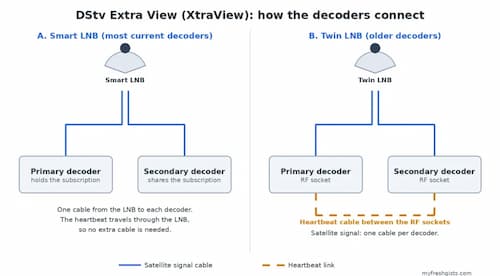
Smart LNB setup (most current decoders)
- Fit a smart LNB on the dish.
- Run one cable from the LNB to each decoder. On an Explora, use the socket marked for the smart LNB, often labelled uni cable.
- You do not need a heartbeat cable. The decoders talk to each other through the LNB.
- In each decoder’s installation settings, give it its own decoder number so they do not clash.
Twin LNB setup (older decoders)
- Fit a twin LNB on the dish.
- Run one cable from each LNB output to each decoder’s satellite input.
- Next, run a separate coaxial heartbeat cable from the primary decoder’s RF socket to the secondary decoder’s RF socket.
- For three decoders, use a splitter on the heartbeat cable so the primary reaches both secondaries.
Mixing old and new decoders can need extra parts, such as a smart switch. This is where an accredited installer saves time and mistakes.
DStv Extra View with a diplexer
A diplexer is a small box that lets two signals share one coaxial cable. In an Extra View setup, it carries the satellite signal and the heartbeat together. That saves you from running a second cable to the other room. Some older decoders, such as the first Explora, also need a diplexer to pass the heartbeat.
A diplexer has three ports. One joins the cable that runs between rooms, one goes to the decoder’s LNB input, and one goes to the decoder’s RF socket. The labels differ by brand, so read them before you connect anything. Do not use an ordinary splitter or combiner, because it will not separate the signals.
- Buy two diplexers, one for each end of the cable.
- In the room with the primary decoder, connect the second LNB feed to the satellite port of the first diplexer.
- Next, connect the primary decoder’s RF socket to the diplexer’s RF port.
- Run one coaxial cable from the diplexer’s combined port to the second room.
- In the second room, connect that cable to the combined port of the second diplexer.
- Then connect the diplexer’s satellite port to the secondary decoder’s LNB input, and its RF port to the decoder’s RF socket.
- Switch both decoders on and check the XtraView status, as shown below.
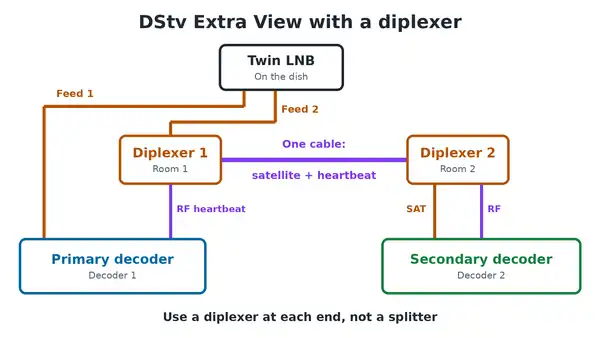
If the heartbeat still does not arrive, the diplexer is often the wrong way round. Swap the cables on its ports and test again.
DStv Extra View Settings on the Decoder
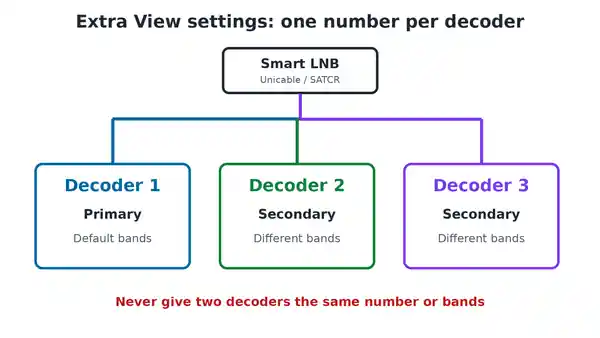
Each decoder in an Extra View setup needs its own decoder number in the installation settings. The primary is usually decoder 1, and the secondary decoders are 2 and 3. With a smart LNB, each decoder must also use its own user bands, so the signals do not clash.
Menu names change between decoder models, but the steps are much the same.
- Switch off the other decoders while you set up one at a time.
- On the remote, open the menu and go to Settings.
- Open the satellite or installation settings, then run the installation wizard.
- Choose the LNB type. Pick Smart LNB, Unicable or SATCR for a smart LNB, or Universal for a twin LNB.
- Set the decoder number. Use 1 for the primary and 2 or 3 for each secondary decoder.
- With a smart LNB, keep the default user bands on the primary, and choose different bands on each secondary.
- Finish the wizard, then restart the decoder at the wall.
- Repeat for the next decoder, then switch them all on.
Keep the decoders within about 30 metres of cable of each other. Longer runs can weaken the heartbeat, especially with older decoders.
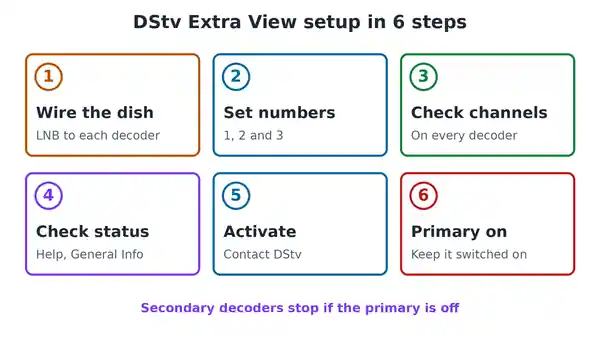
DStv Extra View Setup and Activation Step by Step
Wire the decoders first, check each one shows channels, then confirm the link status on the decoder before asking DStv to activate XtraView. You can request activation through DStv customer care, an agent or your country’s self service options.
- Connect every decoder to the dish as described above.
- Switch all decoders on and check each one shows a DStv channel.
- Check the link status. On many decoders, press Help on the remote, then choose General Information, then scroll to Extra View or XtraView. After activation, it should say the service is ready and active.
- Contact DStv to link the secondary decoders to your account and activate XtraView. Have every decoder’s smartcard or IUC number ready.
- Leave all decoders on and tuned to a channel while the activation arrives.
If channels do not appear after activation, send a reset from your DStv app or self service. Our guide to resetting DStv and fixing channels not showing covers that step.
DStv Extra View Problems and Fixes
“Waiting for communication from primary decoder”
This means the secondary decoder has lost its link to the primary. Most often, the primary decoder is simply switched off or has been in standby too long. Switch the primary on, wait a few minutes, and the secondary usually recovers.
If it does not, check the link. On a twin LNB setup, make sure the heartbeat cable sits firmly in both RF sockets. On a smart LNB setup, check both decoders’ cables at the LNB and confirm their decoder numbers are different.
Error E143 on an Extra View decoder
E143 points to the heartbeat not reaching the secondary decoder. Treat it the same way: keep the primary on, check the heartbeat path, then restart both decoders at the wall.
One decoder shows E48-32, the other works
In this case the dish is fine. The cable or LNB output feeding that one decoder has a fault. Our E48-32 guide shows a quick cable swap test to find the faulty part.
Secondary decoder stops working in another house
DStv Extra View decoders should stay in the same home, connected to the same dish. A secondary decoder taken elsewhere loses its link to the primary and stops working.
Common Questions
Can I connect one DStv decoder to two TVs?
Yes, but both TVs will show the same channel. Use an HDMI splitter, or on older decoders the RF OUT socket and a cable splitter. For different channels in each room, you need DStv Extra View.
How many decoders can I have on XtraView?
Up to three decoders on one subscription: one primary and up to two secondary decoders.
How much does DStv Extra View cost?
You pay your normal subscription plus a monthly access fee for each extra decoder. The fee varies by country and changes over time, so check your country’s DStv website for the current amount.
Do I need a heartbeat cable for Extra View?
Not with a smart LNB, because the decoders communicate through it. Older setups with a twin LNB need a heartbeat cable between the decoders’ RF sockets.
Is Dual View the same as Extra View?
Not quite. Dualview was an older DStv decoder with two tuners, so one box could feed two TVs with different channels. XtraView links separate decoders instead. Many people still say Dual View when they mean DStv in two rooms.
Which Setup Should You Choose?
Choose one decoder with a splitter if your household is happy watching the same channel, because it costs nothing each month. Choose DStv Extra View if each room needs its own channel and its own remote. In that case, budget for a second decoder, a smart or twin LNB, and the monthly XtraView fee, and keep the primary decoder switched on.
For current XtraView fees and activation in your country, start at the official DStv website.

Frenzy valentine is a passionate blogger, developer, and entrepreneur. He is the founder and author of myfreshgists.com.
I like this connection and i would like to have more than two Tvs connected at one decoder.