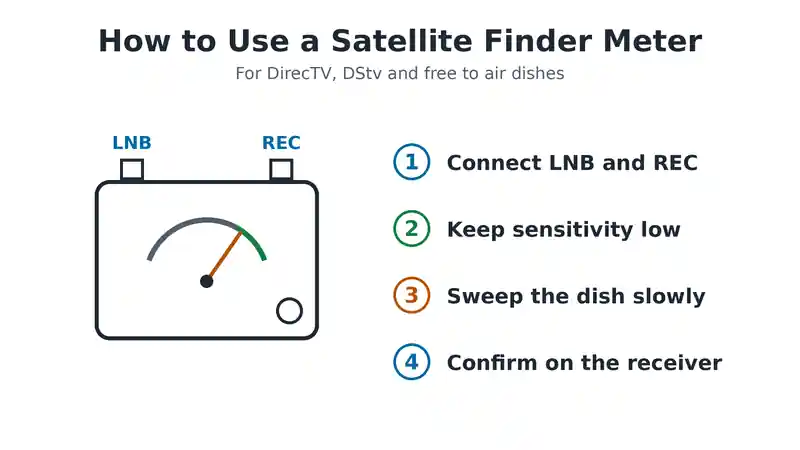
To use a satellite finder meter, connect it between the LNB and the receiver with short cables, set the dish to roughly the right tilt and direction, then sweep the dish slowly until the meter beeps loudest. Lower the sensitivity knob and repeat with smaller moves, then tighten the bolts. Finally, check the receiver’s own signal screen, because the meter cannot tell you which satellite you found.
This guide shows how to use satellite finder meter tools for DirecTV in the US and for DStv in Nigeria and the rest of Africa. It also explains when a cheap meter will not work, which matters a lot for newer DirecTV dishes.
What Does a Satellite Finder Meter Do?
A satellite finder, also called a sat finder or signal finder, is a small box that measures how much satellite signal your LNB is picking up. The LNB is the unit at the end of the dish arm. As you move the dish closer to a satellite, the needle rises and the beep gets louder.
The most common type is a basic inline meter. It has two cable sockets, a needle or bar display, a speaker and a sensitivity knob. It takes its power from the receiver through the cable, so the receiver must be switched on while you work. Some models use a battery pack instead.
Digital meters cost more but go further. They can name the satellite, show signal quality and confirm you are on the right one. For a single home dish, a basic meter plus the receiver’s signal screen is usually enough.
What a basic meter cannot do
A basic meter reacts to any satellite. There are many satellites in the sky, so the loudest beep may come from the wrong one. That is why the last step is always the receiver’s signal screen. If it shows no signal or the wrong channels, you are on the wrong satellite.
Before You Start: Tools and Dish Angles
Gather these before you climb up:
- The satellite finder meter.
- Two short coaxial cables with F connectors, about 30 cm to 1 metre long.
- A spanner or socket set that fits the dish bolts.
- A phone with a compass app.
- Your azimuth, elevation and skew numbers.
- A helper who can watch the TV, if possible.
Azimuth is the compass direction to the satellite. Elevation is how far the dish tilts up. Skew is how far the LNB or dish is rotated. You can get all three from a dish pointing app or website by entering your location. Our guide on how to find satellite position for DirecTV and DISH explains each number.
Setting these numbers first saves a lot of time. The meter then only has to help you with the last few degrees.
How to Use Satellite Finder Meter Step by Step
These steps work for most basic inline meters on DStv, StarTimes, free to air and older DirecTV dishes.
Step 1: Connect the meter
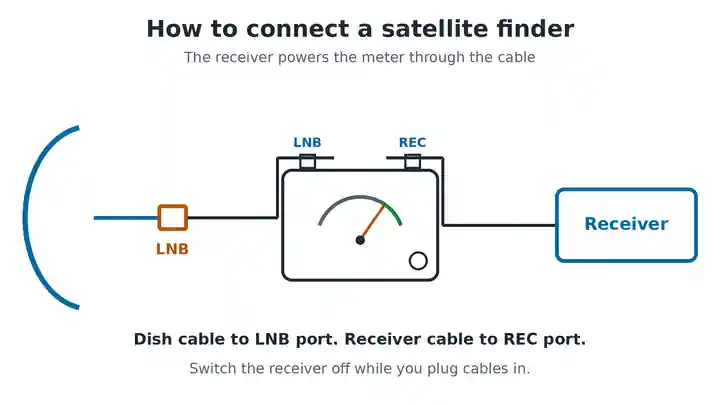
Switch the receiver off at the wall. Unscrew the cable from the LNB. Connect a short cable from the LNB to the socket on the meter marked “LNB” or “To LNB”. Then connect the cable that runs down to your receiver into the socket marked “REC” or “To Receiver”. If you swap them, the meter will not get power and will stay silent.
Step 2: Power it up
Switch the receiver back on. The meter should light up or make a low sound. If nothing happens, check both connections and make sure the receiver is not in standby. Some receivers only power the LNB when they are on a satellite channel or the signal screen.
Step 3: Set the tilt and rough direction
Loosen the elevation bolts just enough to move the dish with some effort. Set the elevation scale on the back of the bracket to your number. Next, loosen the bolts that let the dish turn left and right. Point it at your azimuth using the phone compass. Stand away from the metal dish when you read the compass, because metal throws it off.
Step 4: Set the sensitivity
Turn the sensitivity knob until the needle sits low, around one third of the scale. If you start with it on maximum, the meter will scream everywhere and you will not hear the peak.
Step 5: Sweep slowly left and right
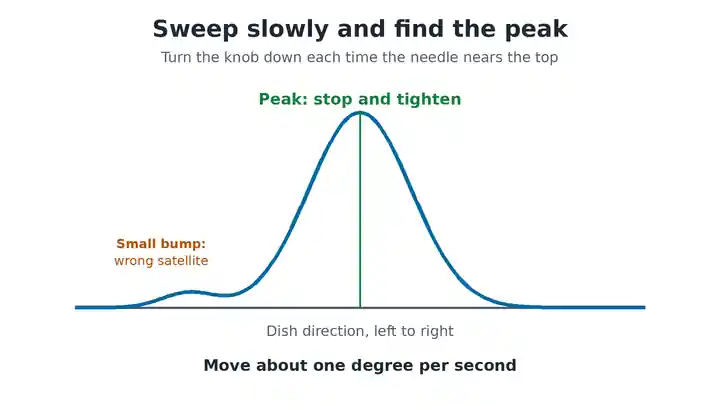
Move the dish a little at a time, about one degree per second, across a wide arc around your azimuth. Listen for the beep to rise. When the needle jumps, stop and move back and forth over that spot to find the highest point.
Step 6: Turn the sensitivity down and fine tune
Once the needle is near the top, turn the knob down until the needle drops back to the middle. Now make tiny moves left and right again to find the true peak. Then do the same with the elevation: tilt up and down by very small amounts. Repeat the knob and fine tune cycle two or three times.
Step 7: Adjust the skew
Rotate the LNB in its clamp, or the whole dish on some DirecTV models, a few degrees each way. Stop where the needle is highest. Our guide on how to fix LNB on a satellite dish shows how the skew scale works.
Step 8: Tighten and check the receiver
Tighten the bolts a little at a time, side by side, while watching the needle. A bolt tightened hard on one side can pull the dish off the peak. Then switch the receiver off, remove the meter and connect the LNB cable directly again. Switch on and open the signal screen. If the numbers are good and the channels play, you are done.
How to Use Satellite Finder Meter for DirecTV
DirecTV is where a cheap meter most often lets people down. Older DirecTV dishes with a standard LNB work with the steps above. Many newer installs use a Slimline dish with an SWM system. SWM stands for single wire multiswitch. It lets one cable feed several receivers, and it uses a power inserter instead of taking power straight from the receiver. Many basic finder meters are not made for this setup, so they may stay silent or give useless readings.
For a DirecTV Slimline or SWM dish, use the receiver’s built-in signal meter instead:
- Press Menu on the DirecTV remote.
- Go to Settings, then Satellite, or Settings and Help, then Settings, then Satellite, depending on your receiver.
- Choose View Signal Strength.
- Ask a helper to read the numbers aloud while you make very small moves at the dish.
The main DirecTV satellite is at 101 degrees West, and Slimline dishes also look at satellites near it, such as 99, 103, 110 and 119 degrees West. If 101 shows good numbers but others are low, the skew or tilt needs a small change. Our guide to checking and increasing DirecTV signal strength explains what each reading means.
If your DirecTV dish was installed by a technician and you are still under contract, DirecTV may send someone to realign it. Moving it yourself is fine, but note the original settings first.
How to Use Satellite Finder Meter for DStv in Nigeria
A basic meter works well with DStv dishes and single or twin LNBs. In Nigeria, Ghana and most of West Africa, DStv uses the Eutelsat satellites at 36 degrees East. The dish faces east, a little south, and tilts up at a fairly high angle. Our guide on DStv signal strength and dish angles lists the direction and tilt for major Nigerian cities.
After you find the peak with the meter, open the DStv signal screen. On most decoders, press Menu, then Settings, then Signal. A good setup shows high strength and high quality. If quality stays low, you may have found a nearby satellite instead, so sweep again a little to each side.
If you have a DStv Explora with a Smart LNB, a basic meter may not read it properly, for the same reason as DirecTV SWM. Use the decoder’s signal screen in that case.
Common Mistakes When Using a Satellite Finder
- Moving too fast. The beam is narrow. A quick swing passes the satellite before the meter can react.
- Leaving sensitivity on maximum. The needle pins at the top and you cannot hear the real peak.
- Locking on the wrong satellite. Always confirm with the receiver’s signal screen.
- Swapping the LNB and REC sockets. The meter gets no power and stays silent.
- Forgetting to tighten evenly. One hard turn on a single bolt can knock the dish off target.
- Blocked view. Trees, walls and roofs in the path stop the signal, however well you aim.
Can You Align a Dish Without a Satellite Finder?
Yes. The receiver’s own signal screen does the same job, just more slowly, because the numbers can take a second or two to update. A helper inside reads the screen while you move the dish in small steps. Our guide on how to align a satellite dish without a meter walks through that method. If the dish still finds nothing, read what to do when your satellite dish says no signal.
Common Questions
Can you get DirecTV without a satellite dish?
Yes. DIRECTV Stream delivers live channels over the internet, so it needs no dish at all. You still need a dish for DirecTV’s satellite service.
Do I need batteries for a satellite finder?
Most basic inline meters take power from the receiver through the cable, so they need no batteries. Some models come with a battery pack for use without a receiver.
Why does my satellite finder beep everywhere?
The sensitivity is too high. Turn the knob down until the needle sits low, then sweep again.
Can a satellite finder damage my receiver?
Not if you connect it correctly and switch the receiver off while you plug cables in and out. A short circuit in the cable is the bigger risk, so check the connectors are clean and tight.
How to Use Satellite Finder Meter Tools the Right Way
Set the tilt and direction first, connect the meter between the LNB and receiver, keep the sensitivity low and sweep slowly. Find the peak, turn the knob down and fine tune, then tighten evenly and confirm on the receiver. For DirecTV SWM dishes and DStv Smart LNBs, rely on the receiver’s built-in signal meter instead. If you rent or live in a shared building in the US, the FCC guide to installing satellite dishes explains your right to put one up.

Frenzy valentine is a passionate blogger, developer, and entrepreneur. He is the founder and author of myfreshgists.com.