If your antenna picks up a weak signal or no channels at all, it’s natural to reach for the multimeter sitting in your toolbox. The problem is that a multimeter cannot actually measure how strong an antenna’s incoming signal is. That job belongs to a completely different kind of tool.
What a multimeter can do is help you find out whether the cable connecting your antenna to your TV is actually the problem in the first place, which is often exactly what you need to know before spending money on a new antenna or a signal booster.
Why a Multimeter Can’t Measure Signal Strength
A multimeter reads voltage, resistance, and continuity, all of which are DC or low-frequency electrical measurements. An antenna signal is a high-frequency radio wave, measured in decibels, and it behaves in ways a standard multimeter was never designed to capture. Trying to read antenna signal strength with a multimeter is a bit like trying to measure how loud a sound is with a ruler. Both are legitimate tools, just for entirely different jobs.
This matters because a lot of guides online blur this line, leaving readers thinking their multimeter is broken when it simply isn’t built for that task. Once you know what each tool is actually for, testing your setup becomes much more straightforward. HOW TO BOOST TV SIGNAL FOR OPTIMUM RECEPTION
What a Multimeter Is Actually Good For
Where a multimeter earns its keep is diagnosing the physical cable and connection between your antenna and your TV or converter box. Coaxial cable has two conductors, a center wire and an outer braided shield, and both can fail independently. A multimeter can tell you whether either one has a break, a short, or a bad connection, which is frequently the real reason behind a weak or missing signal.
Testing for a Broken Center Conductor
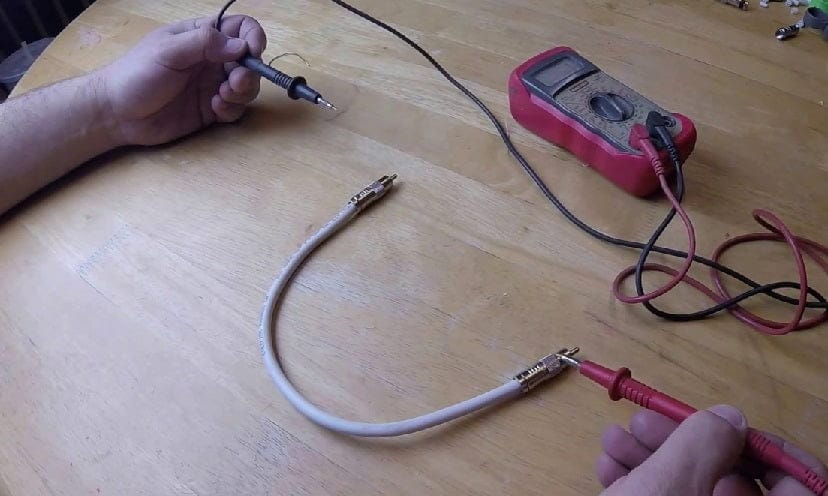
Disconnect the cable completely from both the antenna and the TV before testing anything. Set your multimeter to the resistance or continuity setting, usually marked with an Ω symbol or a sound wave icon. Touch one probe to the center pin at one end of the cable and the other probe to the center pin at the opposite end.
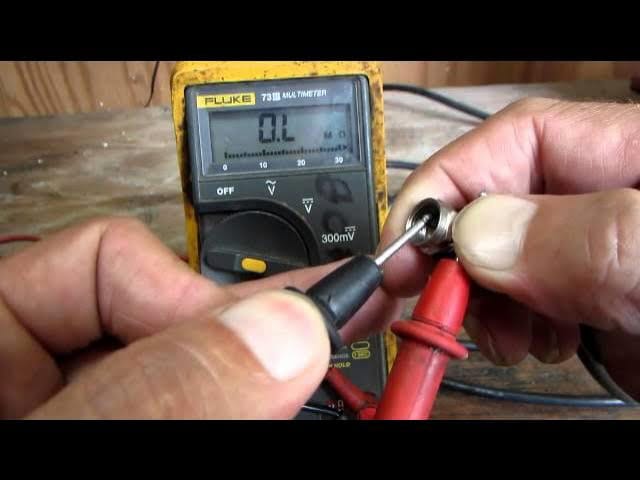
A reading close to zero ohms, or a steady beep if you’re using the continuity setting, means the center wire is intact along its full length. A reading that stays at infinity, sometimes shown as “OL” on digital meters, means there’s a break somewhere inside the cable that needs to be replaced.
Testing the Outer Shield
Repeat the same process, but this time touch the probes to the metal outer shield or connector housing at each end instead of the center pins. Just like the center conductor test, a low reading or a beep confirms the shield is continuous, while an open reading points to a break in the shielding layer.
Testing for a Short Circuit
A short happens when the center conductor and the outer shield touch somewhere they shouldn’t, usually from a frayed strand of shielding or water damage inside a connector. To check for this, touch one probe to the center pin and the other to the outer shield of the same end of the cable.
You want to see no continuity at all here, meaning an infinite or “OL” reading. If the meter beeps or shows a low resistance, the two conductors are touching somewhere along the cable, and that section needs to be replaced rather than repaired.
Checking Antenna Grounding
Poor grounding can also introduce interference into an otherwise healthy signal. With the antenna cable disconnected, touch one multimeter probe to a metal part of the antenna mount and the other to a properly grounded object, such as your home’s electrical grounding rod or a metal cold water pipe.
A reading close to zero ohms confirms a solid ground connection. A higher reading suggests the antenna isn’t grounded properly, which can allow static buildup and interference to affect your picture even when the cable itself is fine.
What to Use Instead for Signal Strength
Once you’ve confirmed the cable and connections are good, checking actual signal strength requires either your TV’s built-in tools or a dedicated signal meter. Most digital TVs made in the last decade have a signal strength and quality screen built into their channel or antenna settings, usually reached through the menu under a setting labeled Antenna, Broadcast, or Channel Setup.
This built-in screen shows both signal strength and signal quality as percentages, and it costs nothing extra to use. For a more precise reading, especially when trying to find the best physical direction to point an outdoor antenna, a dedicated inline signal meter connects between the antenna and the TV and gives a live readout as you rotate the antenna toward different broadcast towers.
Putting It Together
If your antenna signal is weak or missing entirely, start with the multimeter tests above to rule out a bad cable, a short, or a grounding issue, since these are common and inexpensive to confirm. If the cable passes every test, the next step is checking your TV’s built-in signal screen or using a dedicated meter to fine-tune the antenna’s direction.
Working through these steps in order saves you from replacing an antenna that was never actually the problem, or assuming a cable is fine when it was the real cause all along. A multimeter and a signal meter aren’t competing tools, they simply answer two different questions, and knowing which one to reach for saves both time and money. If your signal tests fine but the picture still looks poor, our guide to fixing good signal but poor picture quality covers what to check next. For a deeper technical breakdown of coax testing methods beyond a basic multimeter, this coax cable testing guide from Engineer Fix is a solid reference.

Frenzy valentine is a passionate blogger, developer, and entrepreneur. He is the founder and author of myfreshgists.com.
1 thought on “Can a Multimeter Measure Antenna Signal Strength? How to Test Your Antenna Cable Correctly”