Most people think cable internet is the cheaper option. In the first month, that is often true. Over a full year, and certainly over two or three years, the math starts working against cable in ways that most people never sit down to calculate. This is a straightforward cost comparison of fiber versus cable internet — with real numbers, real scenarios, and a clear answer to the question of when fiber actually pays for itself.
What cable internet really costs over time
Cable providers are experts at leading with a low headline price. In 2026, basic cable plans advertise introductory rates between $20 and $35 per month, and mid-tier plans with 300 to 500 Mbps downloads often start around $50 to $70. Those prices look reasonable. The problem is that they rarely last.
Most cable promotional rates expire after 12 to 24 months. When they do, prices commonly jump by $30 to $50 per month without any change in service. A plan that started at $50 can easily become $80 or $90 before you have noticed. Add an equipment rental fee of $10 to $15 per month for the modem and router, and you are now paying close to $100 for the same service you signed up for at half the price.
Cable plans also frequently include data caps. Exceeding those caps triggers overage charges that appear on your bill without warning. And because cable infrastructure is shared between dozens or hundreds of homes on the same local node, speeds during evening peak hours can fall by 28 to 40 percent compared to what you pay for. The speed you get at 11am on a Tuesday is not the speed you get at 8pm on a Friday.
What fiber internet actually costs in 2026
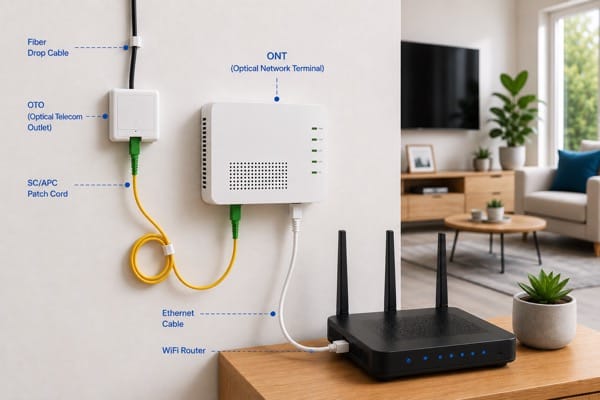
The national average for a standard fiber internet plan in the United States sits at around $85 per month in 2026. Entry-level fiber plans delivering 300 to 500 Mbps run between $50 and $90 per month. Gigabit fiber plans, which deliver 1,000 Mbps both for downloads and uploads, typically cost between $80 and $120 per month depending on the provider and your location.
The key difference is what is included in that price. Most major fiber providers, including Google Fiber, Verizon Fios, and AT&T Fiber, include equipment at no extra charge and offer price-lock guarantees that hold your rate steady for two to four years. Google Fiber starts at $70 per month for their gigabit plan with no contracts and all equipment included. Verizon Fios starts at $50 per month for 300 Mbps with a price guarantee that can run up to four years. There are no data caps on most fiber plans, no overage charges, and no promotional-rate cliff to fall off of.
When you compare the true two-year cost of cable versus fiber — accounting for post-promotional price increases, equipment fees, and overage charges — the gap between them is often smaller than the headline monthly rates suggest, and sometimes fiber works out cheaper over the full contract period.
The upload speed difference that changes the real-world calculation
Monthly price alone does not tell the full story. The single biggest practical difference between fiber and cable in 2026 is upload speed, and it affects far more people than realise it.
A cable gigabit plan typically delivers download speeds of around 1,000 Mbps but caps upload speeds at 35 to 50 Mbps. A fiber gigabit plan delivers 1,000 Mbps in both directions symmetrically. That gap is enormous in practice. Every video call uploads your camera feed continuously. Cloud backup services like iCloud, Google Drive, and Dropbox upload your files in the background. If you create video content and upload to YouTube or Twitch, your upload speed is your entire bottleneck. If two people in your home are on video calls simultaneously while a third device is backing up to the cloud, a cable connection with a 40 Mbps upload ceiling can saturate completely. On fiber, the same household barely touches its capacity.
Research puts the productivity cost of a slow or unreliable connection at roughly one week per year for remote workers. At even a modest salary, that lost productivity is worth hundreds of dollars annually — a cost that never appears on your internet bill but is very real.
How to Calculate Your Internet Outage Cost and Whether Failover Pays Off
When fiber pays for itself: the specific scenarios
Fiber does not pay for itself equally for everyone. The return on investment depends heavily on how you use your connection.
You work from home regularly. This is the clearest case for fiber. Dropped video calls, slow file uploads, and peak-hour congestion all have direct productivity costs. Fiber’s consistent speeds, 70 percent fewer service interruptions compared to cable according to industry data, and symmetrical upload capacity eliminate most of those losses. For a remote worker billing $50 or more per hour, a single avoided outage event recovers several months of the cost difference between fiber and cable.
Multiple people stream, game, or video call simultaneously. Cable’s shared bandwidth becomes a bottleneck fast when several people in one home are all online at once. Fiber’s dedicated connection does not share bandwidth with your neighbours, so peak-hour slowdowns that cable users experience simply do not happen on fiber.
You upload large files, run cloud backups, or create content. If you regularly upload video, back up large files, or sync a creative project to cloud storage, the difference between 40 Mbps and 1,000 Mbps upload speed is a task that takes seconds instead of minutes. Over a year, those minutes add up to hours.
You want to avoid bill surprises. If your cable bill has crept up over two years and you are now paying $90 to $100 per month with a promotional rate long expired, you are likely already paying fiber prices without fiber performance. A switch at that point is straightforward to justify.
When cable is still the right call
Fiber does not win in every situation, and it is worth being honest about that.
If fiber is not yet available at your address, the discussion ends there. Cable internet covers more than 90 percent of US addresses in 2026, while fiber availability remains more limited, particularly outside major metropolitan areas. Check your address with providers directly before drawing any conclusions.
If you primarily use the internet for browsing, email, and occasional streaming on one or two devices, a reliable cable plan at 200 to 300 Mbps covers your needs comfortably. The extra upload speed and congestion resistance of fiber will not make a noticeable difference for lighter usage. If fiber would cost more than $20 per month above your current cable rate and you have no upload-intensive needs, the premium is harder to justify.
If you are locked into a cable contract with meaningful early termination fees, run the numbers on whether the fees outweigh the savings from switching before making a move.
The simple decision framework
Compare the true two-year cost of your current cable plan — including its post-promotional rate, equipment rental, and any data overage history — against the two-year cost of the best fiber option available at your address. Factor in upload speed if you work from home or have multiple users. Factor in reliability if outages have cost you lost work or productivity in the past.
Industry guidance is consistent on the threshold: if fiber costs $10 or less more per month than your true cable cost, the better reliability, included equipment, and symmetrical speeds make it worth switching. If fiber costs $20 or more per month above cable and your usage is light, cable remains the sensible choice. For remote workers and households with heavy upload needs, the threshold where fiber pays for itself is lower because the productivity and reliability savings close the gap quickly. You can check current fiber availability and compare live pricing at your specific address through HighSpeedInternet.com’s fiber vs cable comparison tool. The decision is almost never about which technology is better in the abstract. It is about whether the improvement matches your actual usage — and for a growing number of households in 2026, it does.

Frenzy valentine is a passionate blogger, developer, and entrepreneur. He is the founder and author of myfreshgists.com.