Most business owners think about internet outages the wrong way. They remember the last time the connection went down, estimate they lost a few hundred dollars, and move on. The real number is almost always three to five times larger than that first guess — and once you calculate it properly, the ROI of investing in a failover connection becomes obvious. Here is exactly how to work it out.
Why most businesses underestimate internet downtime cost
The average internet downtime event lasts 87 minutes, according to industry research. Eighty percent of businesses experience at least one outage per year, and most experience three to five. Run those numbers and you are looking at four to seven hours of downtime annually as a conservative baseline — before accounting for partial outages, degraded speeds, or the slow recovery time after your systems come back online.
Most owners only count direct lost revenue. They forget that employees keep getting paid whether the internet works or not. They forget the cloud subscriptions running in the background that are useless during an outage. They forget the IT support bill, the overtime to catch up, and the customers who quietly leave and never come back. When you add all of that together, the true cost of internet downtime looks very different from the headline number.

The formula: how to calculate your outage cost
The correct formula for calculating internet downtime cost is straightforward. Add up five components: lost labor, lost revenue, operating costs wasted during the outage, recovery costs, and intangible costs. Written simply it looks like this.
Total Outage Cost = Lost Labor + Lost Revenue + Wasted Operating Costs + Recovery Costs + Intangible Costs
Work through each one in order.
Lost labor. Take the number of employees affected, multiply by their average hourly cost, and multiply again by the number of hours the outage lasts. If you have 10 employees averaging $30 per hour and the internet goes down for two hours, you have just lost $600 in labor costs for work that cannot be recovered. Your payroll does not pause because your router does.
Lost revenue. Industry research consistently puts lost revenue at two to ten times lost labor cost, depending on how directly your sales depend on connectivity. A retail business with a cloud-based POS system loses every sale during the outage window. A consulting firm loses billable hours. An ecommerce store loses every order attempt. For a conservative calculation, use three times your lost labor figure. A business with $600 in lost labor therefore estimates around $1,800 in lost revenue for that same two-hour outage.
Wasted operating costs. You are paying for internet service, cloud software licences, VoIP phone systems, and a dozen other tools that stop working the moment the connection drops. Total up your monthly software and connectivity costs, divide by 720 to get an hourly rate, and multiply by outage hours. For most small businesses this adds $50 to $200 per outage event.
Recovery costs. These are easy to miss entirely. Recovery costs include IT support call-out fees, employee overtime to catch up on missed work, and any penalty fees triggered by missed SLAs with clients. Emergency IT support typically runs two to three times the standard hourly rate. If your outage costs you two hours of a technician’s time at emergency rates, add that to the total.
Intangible costs. This is the category most businesses never put a number on, but research shows it is often the most expensive over time. Customers who cannot complete a transaction during an outage may not return. Negative reviews posted in frustration have a long shelf life. Repeated outages damage the trust of staff and clients alike. A conservative estimate puts intangible costs at 10 to 20 percent of your direct losses per event.
Why Your Internet Drops at 9 AM Every Day ( How to Fix It)
What the industry benchmarks tell you
If you want to pressure-test your calculation against real data, the 2026 benchmarks are clear. Gartner and ITIC put average enterprise network downtime at $5,600 to $9,000 per minute. For small and mid-sized businesses, Datto’s research puts the figure at $8,000 per hour, while other industry data shows SMB outage costs ranging from $137 to $427 per minute depending on sector and size. At the high end of those figures, a three-hour outage at a 20-person company can easily clear $50,000 in combined direct and indirect losses.
The annual picture is equally striking. The average small business loses approximately $7,800 per year to internet downtime, according to analysis from Vivant. That figure assumes relatively infrequent, short outages. Businesses in retail, healthcare, financial services, or any operation running cloud-dependent POS systems or telehealth platforms can lose multiples of that figure in a single bad day.
Now calculate the ROI of a failover connection
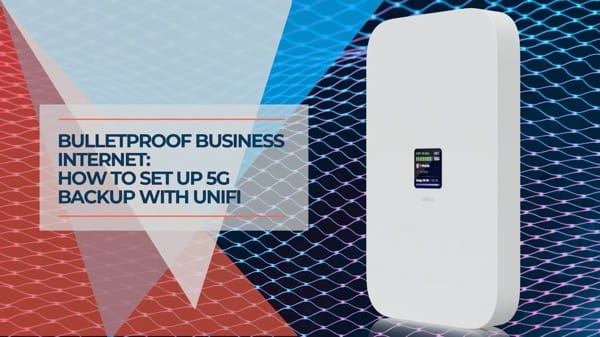
Once you know your annual downtime exposure, the ROI calculation for internet failover is simple arithmetic. A 5G or LTE failover connection costs between $50 and $150 per month for most small businesses, putting the annual investment at $600 to $1,800. An automatic failover system detects when your primary connection drops and switches to the cellular backup in seconds, with no manual intervention required.
Compare that to your annual downtime cost. If your business loses $7,800 per year to outages and a backup connection costs $1,200 per year, the investment pays for itself after preventing less than one average outage event. In year one the ROI is already strongly positive. In year two it is even clearer, because the $1,200 cost is fixed while your downtime exposure only grows as your operation becomes more dependent on cloud tools and connected systems.
The payback period for most small businesses is under two months. For businesses in high-dependency sectors like retail, restaurants, and professional services, it is measured in days.
The SLA gap most businesses never check
One number that changes the calculation significantly is what your current internet provider actually guarantees. A 99.9 percent uptime SLA, which sounds impressive, still allows 8.8 hours of downtime per year under the contract. A 99.99 percent SLA reduces that to 52 minutes. If your provider is at the 99.9 level and your hourly downtime cost is $2,000, that SLA permits up to $17,600 in annual losses before you can even make a formal complaint.
Check your current SLA, find the uptime guarantee and the credits you receive for breaches, and calculate whether those credits come close to covering your actual losses. For most small businesses, they do not. The credit you receive for a four-hour outage is typically a small percentage of one month’s bill, while your actual cost runs into thousands of dollars.
A simple decision framework
Run through three questions to decide whether failover investment makes sense for your business right now. First, what is your estimated hourly cost of downtime using the formula above? Second, how many hours of downtime do you experience in a typical year based on your history or industry averages? Third, what would an automatic failover connection cost per year at current market rates? If your annual downtime cost is greater than twice the annual cost of a failover solution, the investment is straightforward to justify. For the majority of businesses that depend on cloud software, payment processing, or remote connectivity, the answer comes out the same way every time: the cost of the backup connection is far smaller than the cost of the problem it solves. For a deeper breakdown of downtime cost benchmarks by company size and industry, the Splunk and Cisco 2026 downtime report analysis is one of the most thorough datasets publicly available. The math is not complicated. Most businesses just never sit down to do it.

Frenzy valentine is a passionate blogger, developer, and entrepreneur. He is the founder and author of myfreshgists.com.