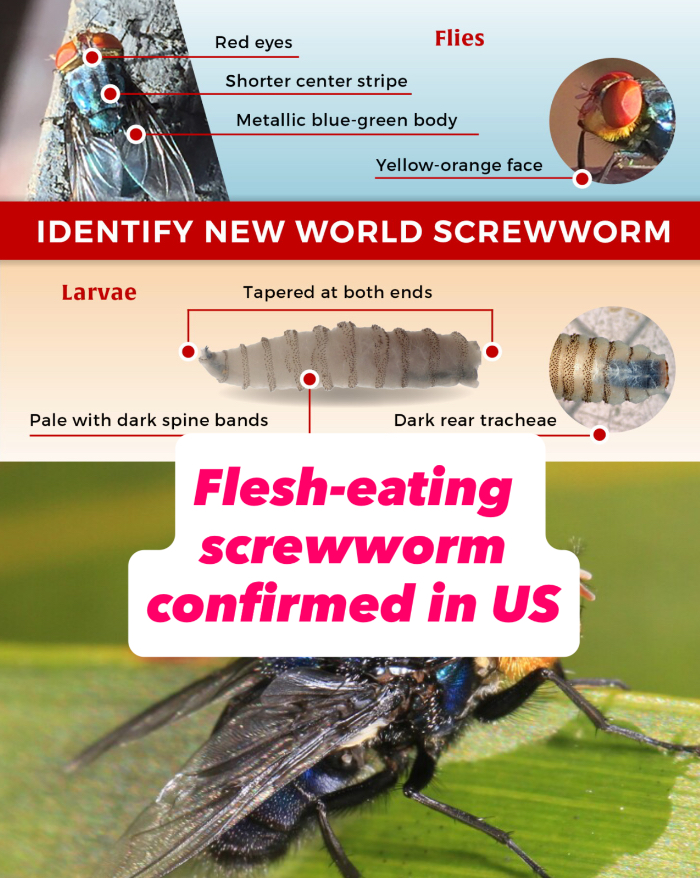
A flesh-eating parasite that the United States wiped out decades ago is back. On June 3, 2026, the U.S. Department of Agriculture confirmed a case of New World screwworm in a calf in Zavala County, Texas. It is the first time the pest has been found in the country since 2017, and officials are moving fast to stop it from spreading.
The infected animal is a three-week-old calf in the town of La Pryor, near the Mexican border. Inspectors found the larvae in the calf’s umbilical area. So far, the USDA says there are no other confirmed detections.
What the screwworm actually is
The New World screwworm is a type of blowfly, and what makes it so dangerous is how it breeds. Unlike most flies, it lays its eggs in the open wounds of living animals rather than dead ones. A cut as small as a tick bite can be enough to attract a female.
Once the eggs hatch, the maggots burrow into living flesh and feed. In their final stage they grow tiny hooks and dig deeper, which is how they got the name screwworm. The wounds become painful and foul-smelling, and if the infestation is not treated early it can lead to severe tissue damage or death. A single female can lay up to 300 eggs at a time and as many as 3,000 over her short life.
Can it infect people?
Yes, but it is rare, and the risk to the public right now is low. The screwworm mainly targets livestock, pets, and wildlife. In uncommon cases it can infest humans, entering through a wound or a body opening such as the eyes, nose, mouth, or ears.
It is worth being clear about what this case is and is not. The June 3 detection is a calf, not a person. The CDC says there have been no locally acquired human infections in the United States. There was one travel-related human case last year in Maryland, in a patient who had recently returned from El Salvador, but that person recovered and the infection did not spread.
Why officials are so worried
The bigger threat here is to the cattle industry. The screwworm was declared eradicated in the U.S. in 1966 after a long campaign, and a small outbreak in the Florida Keys was stamped out in 2017. Keeping it out has protected one of the country’s most important agricultural sectors for generations.
This matters even more right now because U.S. cattle numbers are at their lowest in about 75 years. The USDA has warned that a screwworm outbreak could cost the Texas economy as much as $1.8 billion, and Texas alone has a cattle industry worth roughly $15 billion. Higher costs for ranchers can eventually mean higher beef prices for everyone.
The parasite has been creeping north since a 2023 outbreak spread through Central America and Mexico. Mexico reported a sharp rise in animal cases during the summer of 2025, and experts say the fly has now slipped past the biological barriers that held it back for decades.
How the US is fighting back
The USDA and Texas Animal Health officials have set up a quarantine zone covering about 12 miles around the site. They have also started one of the strangest and most effective tools in the playbook: releasing sterile male flies into the area.
The logic is simple but clever. When females mate with sterile males, their eggs never hatch, and the population collapses over time. This same method is what beat the screwworm back in the past, and it remains the gold standard for control today.
Ranchers in the region are being urged to check their animals closely, especially newborns, for draining wounds, signs of discomfort, or maggots near body openings. Early detection is the difference between a single case and a full outbreak. For now, the message from officials is steady rather than panicked: the threat is real, the response has started, and the public risk remains very low.

Frenzy valentine is a passionate blogger, developer, and entrepreneur. He is the founder and author of myfreshgists.com.